


Many people prefer to use traditional methods to remove calluses, even though there are much more effective alternatives. Swellings on the feet are often treated with pumice stones, rasps and files. Often, the feet develop calluses and pressure points, which can be very dangerous, especially for type 2 diabetics. It is known that the diabetic foot requires special care. This should only be done by an experienced podiatrist. For all other people, effective callus removal with Mosadal liquid and Mosadal cream is recommended. But first, let's take a look at the reasons why sweaty feet, pressure points, calluses and excess calluses on the ball of the foot and heel actually develop. Why do we humans actually have calluses? In the past, you didn't need a podiatrist to regularly remove cuticles and excess calluses. On the contrary, in the early days of human history, humans even needed a thick layer of calluses to be able to hunt barefoot or on thin pieces of leather under the soles of their feet. Even today, many indigenous people do not wear shoes. Therefore, they do not suffer from foot problems caused by shoes or wrongly chosen socks. Instead, thick layers of horn protect the soles of the feet from injury. Compression stockings were also unknown among indigenous people. They were also not necessary due to the high movement profile of the tribe members. From this point of view, the formation of calluses was a protective device that the body used in the early days of mankind. In the meantime, however, our calluses have become quite obstructive and visually disturbing due to modern developments and a largely sedentary lifestyle. They are unattractive remnants of our evolutionary development. However, it is interesting to note that despite all civilizational development, it is still our brain that creates and controls callus formation. Every manual removal of callus areas by means of pumice stone or rasping gives rise to a new formation of callus areas. One can even jokingly speak of a certain yo-yo effect. The organism still tries to protect itself against injuries in this way. This cycle can be interrupted and regulated with Mosadal. Gradually, callus formation becomes weaker through the application of Mosadal's liquid. The overwhelming smell of cheese feet disappears at the same time with proper foot care. With Mosadal, cuticle and callus removal becomes child's play, with a long-lasting effect with frequent use. Remove calluses on feet with Mosadal lotion and foot bath tub Finally, even immobile people can remove calluses on their feet easily, without discomfort and without much effort. The MOSADAL foot tub has been designed so that the heel and ball of the foot can be precisely and specifically soaked with the MOSADAL lotion: For example, there is a depression at the lower edge of the MOSADAL foot basin. The purpose of this is that the often stubborn and very pronounced calluses on the heel can be softened and removed particularly effectively in this depression. The middle part of the MOSADAL foot basin, which is slightly curved, is also particularly practical with its rough surface. Here, the callus can be roughly planed in advance.


Simply select the areas to be treated and place a layer of cotton wool in the foot bath at the relevant spots. Then soak with MOSADAL lotion and place the calloused areas on the moistened cotton wool. To increase the surface and allow the MOSADAL lotion to better absorb into the dead tissue, we recommend gently roughening the skin on the surface. It is important that the callus is dry - warm - rough.


Step 1: The innovative Mosadal foot bath tub is delivered.Step 2: Now Mosadal lotion comes into play. Simply select the areas to be treated and place a layer of cotton wool in the foot bath at the relevant spots. Then saturate with MOSADAL lotion and place the calloused areas on the moistened cotton wool. To increase the surface and allow the MOSADAL lotion to better absorb into the dead tissue, we recommend gently rubbing the skin on the surface. Now allow the lotion to take effect for 10-30 minutes (depending on the thickness of the callus). Afterwards, the hard callus that has turned into jelly is simply carefully scraped off with the patented scraper in the middle of the MOSADAL foot basin. It is made of a particularly strong plastic and - like the stainless steel spatula from MOSADAL - ensures effective removal of the dead callus that has turned into jelly.
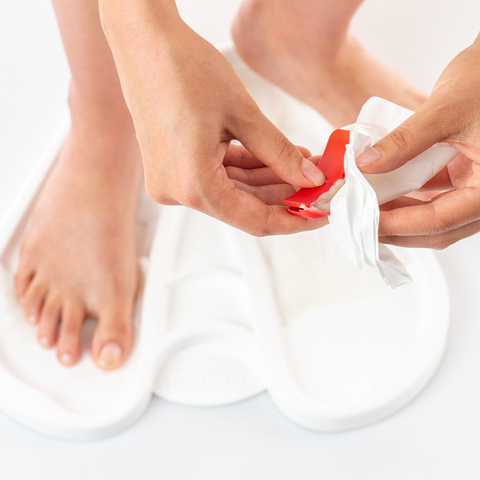

Step 3: Make yourself comfortable and position your feet. Step 4: On the rough bulge in the middle of the foot basin, the callus can be roughly pre-treated. Cover the side areas of the big toe, which often have particularly pronounced and hardening calluses, with a thin layer of cotton wool from the side, apply a few drops of MOSADAL lotion and leave it on for 10-30 minutes. To permanently protect the skin from renewed calluses, apply MOSADAL Urea Cream to your feet once a day. Now allow the lotion to take effect for 10-30 minutes (depending on the thickness of the callus). Afterwards, the hard callus that has turned into jelly is simply carefully scraped off with the patented scraper in the middle of the MOSADAL foot basin. It is made of a particularly strong plastic and - like the stainless steel spatula from MOSADAL - ensures effective removal of the dead callus that has turned into jelly.